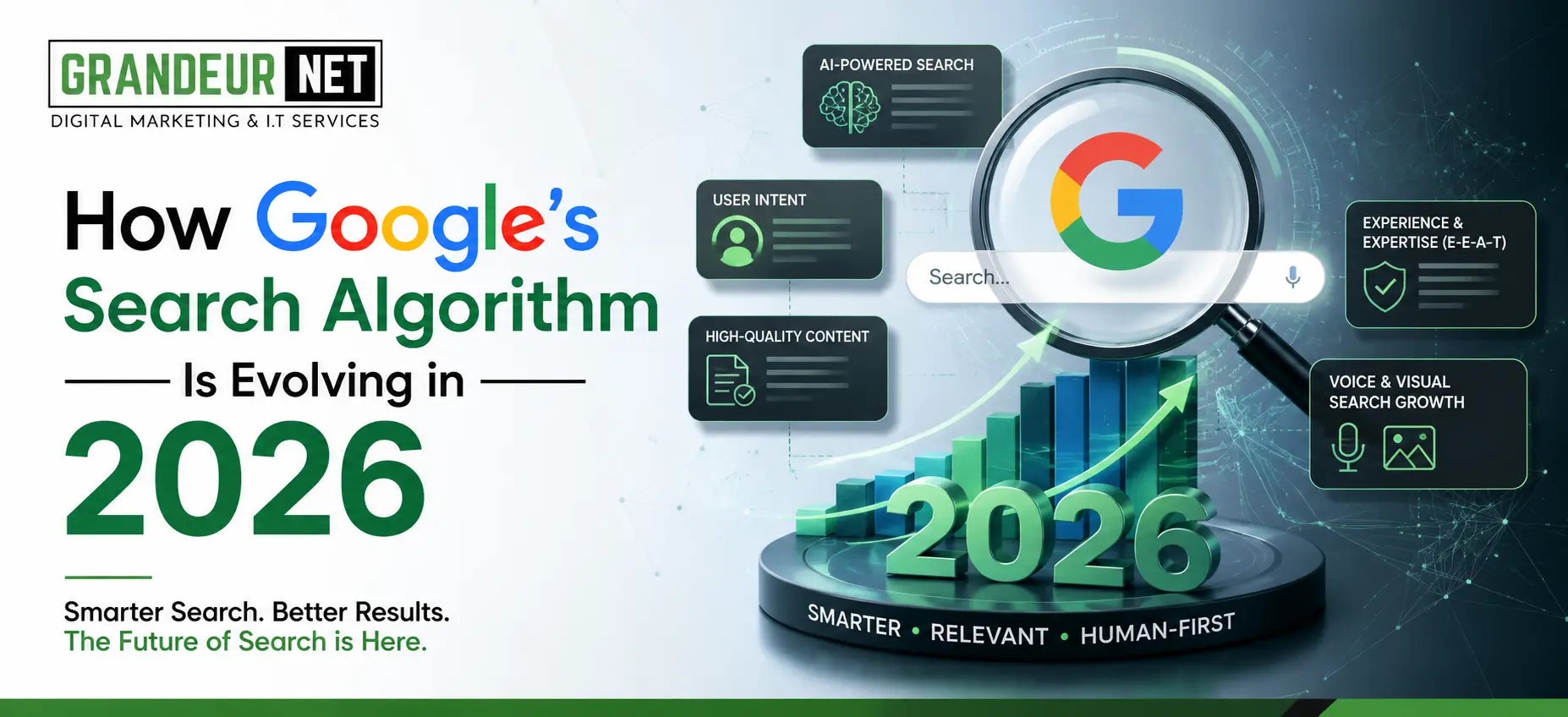
Quick answer: In 2026, Google's search algorithm has moved away from isolated ranking tweaks toward continuous, AI-integrated quality evaluation. Core updates now arrive faster and more frequently, AI Overviews and AI Mode influence a large share of queries, and ranking factors increasingly reward originality, E-E-A-T signals, Core Web Vitals performance, and content built for both human readers and AI systems. We track these shifts daily so businesses can adapt before losing visibility — this guide breaks down exactly what changed and what to do next.
What Is the Google Search Algorithm, and Why Does It Keep Changing?
Google's search algorithm is the system that decides which pages appear, and in what order, for a given query. Rather than one fixed formula, it is a layered set of ranking systems evaluating relevance, quality, trust, and usefulness across hundreds of signals simultaneously.
In 2026, Google has picked up the pace of change. Confirmed rollouts include a February 2026 Discover Core Update, a March 2026 Spam Update followed almost immediately by a March 2026 Core Update, a May 2026 Core Update, and a June 2026 Spam Update — with continued volatility reported into August. Google made five confirmed algorithm updates between February and June 2026 alone. That cadence means site owners can no longer treat SEO as a "set it and forget it" task — it now requires ongoing monitoring, much like the approach we follow for clients at Grandeur Net.
Key Ways Google's Algorithm Is Evolving in 2026
1. Faster, More Frequent Core Updates
The March 2026 core update began on March 27 and completed on April 8, producing significant ranking volatility as SEO professionals worked to understand the shifts. The follow-up May 2026 core update rolled out over roughly two weeks, with Google describing it as a regular update meant to better surface relevant, satisfying content for searchers from all types of sites. This tighter turnaround between major updates signals that Google is refining its systems continuously rather than in occasional, isolated overhauls.
2. AI Overviews and AI Mode Are Reshaping the Results Page
Following Google I/O 2026, AI-generated answers became a default part of how many users experience search, alongside a broader redesign of the results interface. A 2026 study by SparkToro found that 68% of Google searches in the U.S. ended with no click to any website at all in the first four months of the year, up from about 60% two years earlier — a clear sign that AI-driven answers are absorbing a growing share of search intent.
3. Original, First-Hand Content Is Rewarded Over Repetition
The March 2026 core update placed heavy weight on how much genuinely new information a page contributes, compared to content that already ranks for the same query. Thin rewrites, AI-generated filler, and duplicated angles are losing ground to pages built on direct experience and original research.
4. E-E-A-T and Author Credibility Carry More Weight
Across the March and May updates, the SEO community observed that topical authority, content freshness, and strong E-E-A-T signals played an even greater role in rankings, with businesses publishing regularly updated, expert-led content weathering updates better than sites left untouched for months or years.
5. Core Web Vitals and Technical Performance Matter More
Sites with strong Core Web Vitals scores gained roughly 12% to 28% more traffic during the March 2026 rollout, while low-effort AI content and expired-domain abuse lost visibility. Page speed, mobile responsiveness, and clean technical foundations are no longer "nice to have" — they're a ranking prerequisite.
6. Spam Enforcement Is Tightening
The June 2026 Spam Update specifically targeted scaled content abuse, expired domain abuse, and other manipulative tactics rather than genuinely helpful information, reinforcing that shortcuts are becoming less viable as a long-term strategy.
7. Search Is Becoming Agentic
At I/O 2026, Google expanded Search into agent-like capabilities — Search can now synthesize information and take action on a user's behalf, such as continuously scanning listings for someone apartment hunting and notifying them when matches appear, alongside expanded agentic booking for services like local experiences. This shift means visibility depends not just on ranking, but on being structured clearly enough for AI agents to read, trust, and act on.
Updated Google Ranking Factors to Watch in 2026
| Ranking Factor Why It Matters Now | |
| Content originality | Rewards firsthand insight over rehashed content |
| E-E-A-T signals | Credentialed, expert-led content recovers faster after updates |
| Core Web Vitals | Directly tied to traffic gains/losses in 2026 rollouts |
| Structured data | Helps both classic rankings and AI Overview citations |
| Content freshness | Regularly updated pages outperform stale ones |
| AI/answer-readiness | Clear, direct answers get cited in AI Overviews and AI Mode |
How to Adapt Your SEO Strategy for 2026
- Audit top pages for genuine expertise — attribute content to credentialed authors and add firsthand data or experience.
- Fix Core Web Vitals issues, especially Largest Contentful Paint failures from heavy images or render-blocking scripts.
- Structure content for direct answers — clear headers, concise definitions, and scannable formatting help both users and AI systems extract information.
- Update content regularly instead of publishing once and leaving it untouched.
- Avoid scaled or low-effort AI content — Google's spam systems are actively targeting it.
- Monitor Search Console after every confirmed update to separate temporary volatility from genuine quality issues.
This is exactly the kind of ongoing, adaptive strategy the team at Grandeur Net builds for clients — because in 2026, SEO success depends less on chasing individual algorithm changes and more on consistently meeting the quality bar Google (and its AI systems) are measuring against.
Conclusion
Google's search algorithm in 2026 isn't just getting smarter — it's evolving into a system where traditional rankings, AI Overviews, AI Mode, and agentic search all draw from the same underlying quality signals: originality, expertise, technical performance, and genuine usefulness to real people. Businesses that treat SEO as a continuous discipline rather than a one-time project are the ones weathering these updates best. At Grandeur Net, a trusted SEO company in Dehradun, we help businesses stay ahead of these shifts with strategies built around what Google is actually rewarding in 2026 — not outdated tactics that no longer work.
Frequently Asked Questions
Recent Insights

Top 10 Best SEO Company in Dehradun
Sep 21, 2026
Why Digital Marketing Careers Are Booming in 2026–2027
Sep 14, 2026
How Long Does It Take to Build a Business Website?
Sep 11, 2026
How AEO Is Changing the Future of Search Marketing
Sep 8, 2026